Why Is Azerbaijan Called the Land of Fire?
Some countries create their own tourism slogans.
Others receive them from history itself.
Azerbaijan belongs to the second category.
Today, millions of people recognize the phrase Land of Fire. It appears in airports, at international tourism exhibitions, in advertising campaigns, and in travel guides. Many believe it is simply a successful marketing slogan created to attract visitors.
In reality, the story began long before tourism even existed.
First came the Land of Fire.
Tourism followed centuries later.
The origin of this name has nothing to do with advertising or a beautiful legend.
It began with a natural phenomenon that people could not explain.
The ground was burning.
Not because of lightning.
Not because of volcanoes.
Flames emerged directly from cracks in the earth and continued burning for weeks, months, and sometimes even years.
Today we know the reason.
Natural gas escaping to the surface.
For ancient people, however, it was nothing short of a miracle.
That is why Azerbaijan earned a name that has survived for thousands of years.
When did fire become part of history?
Today, the Absheron Peninsula is famous for its vast oil and natural gas reserves. Thousands of years ago, however, no one knew what lay beneath the ground.
People saw something entirely different.
Imagine arriving on the shores of the Caspian Sea after a long journey.
As evening falls, you notice a faint glow in the distance.
At first, you assume someone has built a campfire.
But as you get closer, you realize there are no people.
No wood.
No fire pit.
The earth itself is burning.
Flames rise directly from cracks in the rocks, continuing to burn regardless of wind, rain, or the changing seasons.
Stories like these spread quickly along ancient trade routes. Merchants shared them in Persia, India, the Middle East, and eventually across Europe.
Some listeners believed them.
Others dismissed them as exaggerated tales.
Yet with every passing century, more travelers witnessed the phenomenon with their own eyes.
Gradually, what once sounded like a legend became historical fact.
Travelers wrote about these eternal flames long before tourism existed
What makes this story remarkable is that Azerbaijan's eternal flames appear not only in legends but also in historical records written across many centuries.
One of the earliest authors to describe the region's unusual natural features was the ancient Greek geographer Strabo. Although he did not specifically mention modern-day Yanar Dag, his writings describe the Caucasus as a land of extraordinary natural phenomena.
Nearly a thousand years later, the Arab geographer Istakhri wrote about fire worshippers living near present-day Baku. His accounts are among the earliest written sources linking the Absheron Peninsula with the ancient cult of fire.
In the 13th century, Marco Polo traveled through the region. He described the area around Baku as a land rich in oil, noting that local people used it for lighting, heating, and various practical purposes. Even then, Azerbaijan's natural resources were known far beyond the Caucasus.
In the 17th century, German traveler and scholar Engelbert Kaempfer visited Surakhani and personally witnessed natural gas vents where flames burned continuously. To Europeans of his time, the sight seemed almost unbelievable.
Later, French writer Alexandre Dumas traveled through the Caucasus and visited Ateshgah. He described the fire temple built around natural flames and admitted that he had never seen anything comparable during his travels.
These travelers lived centuries apart.
They spoke different languages.
They journeyed for entirely different reasons.
Yet they all described the very same phenomenon.
Fire that burned without human intervention.
That is why historians today consider these accounts not as myths, but as reliable eyewitness testimonies.
Why was fire considered sacred?
Today it is easy to explain the source of these flames.
Thousands of years ago, however, no one understood why fire emerged from the ground and continued burning without fuel.
To ancient civilizations, places like these were sacred.
Fire symbolized life, purity, light, and divine power.
It is therefore no surprise that natural gas vents gradually became places of worship.
Zoroastrianism, one of the world's oldest religions, played a particularly important role here.
In Zoroastrian belief, fire represented purity, wisdom, and divine truth. Importantly, followers did not worship the flames themselves but rather the spiritual values they symbolized.
That is why natural flames attracted pilgrims.
People came here to pray.
Over time, temples were built around these extraordinary places.
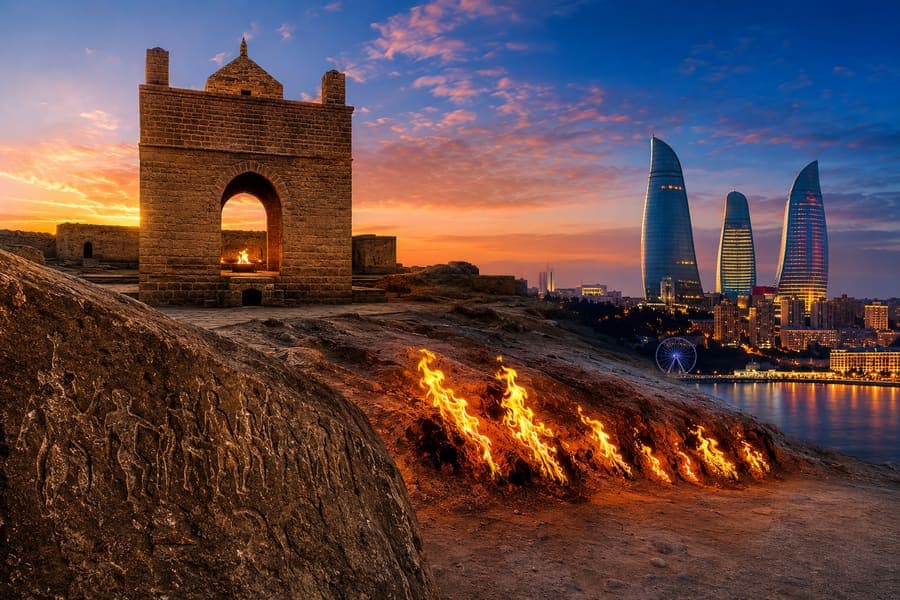
The most famous of them became Ateshgah.
Yet even here, nature came first.
First there was fire.
Then came people.
Only afterward was the temple built.
Ateshgah – A Temple Created by Nature
Today, Ateshgah is one of the most visited historical attractions near Baku. At first glance, it appears to be simply another ancient architectural monument.
In reality, its greatest value lies not in its walls.
Had natural gas never reached the surface here, the temple would most likely never have existed.
The name Ateshgah comes from the Persian words atash meaning "fire" and gah meaning "place" or "home." It is commonly translated as "The House of Fire."
People first came here not because of a temple, but because of the natural flames rising from the ground.
The fire required no wood.
No oil.
No human hand to keep it alive.
It seemed as if the earth itself was breathing.
Centuries later, a place of worship was built around this extraordinary natural phenomenon.
The Ateshgah complex that visitors see today was constructed by Indian merchants and pilgrims during the 17th and 18th centuries. However, the site had been regarded as sacred long before the temple itself was built.
That is why Ateshgah is far more than a historical monument.
It is a place where nature and human history have been connected for thousands of years.
Yanar Dag – Where the Earth Still Burns
If Ateshgah tells the story of the past, Yanar Dag allows visitors to witness that history in the present.
The name Yanar Dag literally means "Burning Mountain."
In reality, it is not a mountain at all.
It is a hillside where natural gas has been burning continuously along the slope for decades.
During the day, the flames are fascinating.
After sunset, they become unforgettable.
Long ribbons of fire emerge directly from the ground, illuminating the rocks with a warm orange glow.
Most first-time visitors assume someone has lit a massive bonfire.
But there is no bonfire.
No hidden gas pipes.
The flames are entirely natural.
This is what makes Yanar Dag one of Azerbaijan's most extraordinary natural landmarks.
Few people realize that centuries ago there were many places like this across the Absheron Peninsula.
Travelers from the 17th, 18th, and 19th centuries described numerous locations where flames rose naturally from cracks in the earth.
Today, almost all of them have disappeared.
That is precisely why Yanar Dag is so valuable.
It is not a reconstruction.
Not a museum exhibit.
Not a man-made attraction.
It is one of the last places where visitors can still witness the natural phenomenon that gave Azerbaijan its worldwide reputation.
Why Have Most Eternal Flames Disappeared?
The answer lies in Azerbaijan's oil history.
During the second half of the 19th century, Baku became one of the world's leading oil-producing regions.
Large-scale extraction of oil—and later natural gas—began to transform the landscape.
As underground pressure changed, many natural gas vents gradually disappeared.
Without those gas outlets, the eternal flames also vanished.
That is why Yanar Dag has become so unique today.
It preserves a rare natural phenomenon that was once common throughout the Absheron Peninsula.
Why Is Azerbaijan Known as the "Land of Fire"?
Today, Land of Fire is recognized as Azerbaijan's official tourism brand.
However, the idea behind the name is far older than modern tourism.
Historians continue to debate the origin of the name Azerbaijan.
The most widely accepted theory connects it to Atropates, the ruler of the ancient kingdom of Atropatene, established after the collapse of Alexander the Great's empire.
Another well-known interpretation associates the country's name with ancient Persian words related to fire or "guardian of fire."
Although most historians consider this interpretation symbolic rather than a proven etymology, there is little disagreement about one fact.
For centuries, travelers associated Azerbaijan with a land where fire emerged naturally from the earth.
That remarkable phenomenon shaped the country's image long before tourism existed.
The name Land of Fire was not invented by marketers.
It was created by history itself.
Flame Towers – A Modern Symbol Inspired by Ancient Fire
Today, it is impossible to imagine Baku's skyline without the Flame Towers.
The architects could have chosen almost any design.
Instead, they selected the one symbol that has represented Azerbaijan for centuries.
Fire.
The three towers resemble giant flames rising above the city.
By day, they dominate Baku's skyline.
At night, their façades transform into enormous digital displays featuring moving flames.
For visitors, it is an impressive light show.
For Azerbaijanis, it is a reminder that the country's identity was shaped long before the construction of modern skyscrapers.
Few places in the world have managed to transform a symbol that is more than two thousand years old into such an iconic piece of contemporary architecture.
How to Experience the Land of Fire in One Trip
Most journeys through Azerbaijan begin in Baku.
And for good reason.
Spend a few days exploring the Old City, the Maiden Tower, and the Palace of the Shirvanshahs before heading beyond the city center.
A visit to Ateshgah and Yanar Dag offers the clearest answer to the question of why Azerbaijan is known as the Land of Fire.
As evening falls, head to one of Baku's panoramic viewpoints to watch the Flame Towers illuminate the skyline.
Many travelers choose to book a hotel in Baku for several nights, allowing enough time to experience both the city's historical heritage and its modern landmarks without rushing.
From there, the journey can continue across the country.
Discover the ancient petroglyphs of Gobustan.
Explore the mountain landscapes of Gabala.
Visit the Shahdag Mountain Resort.
Experience the subtropical nature of Lankaran.
Travel to Guba and the unique village of Krasnaya Sloboda.
Or relax in Naftalan, home to the world's only therapeutic resort based on Naftalan oil.
With a wide selection of hotels across Azerbaijan, it is easy to create an itinerary that reveals many different sides of the country.
A Story That Nature Wrote
Some countries build their identity through legends.
Azerbaijan's story is different.
Nature came first.
Then came the astonishment of the earliest travelers.
Their stories became historical records.
Those records became part of history.
And thousands of years later, Land of Fire became the country's official tourism brand.
That is why the answer to the question "Why is Azerbaijan called the Land of Fire?" is far more fascinating than many people expect.
It is not simply a beautiful legend.
Nor is it a marketing slogan.
It is the story of a remarkable natural phenomenon that has amazed travelers for thousands of years.
And when you finally stand before the flames of Yanar Dag, you realize that some stories cannot truly be understood from books alone.
They must be experienced in person.