Maiden Tower in Baku — History, Mysteries and Legends
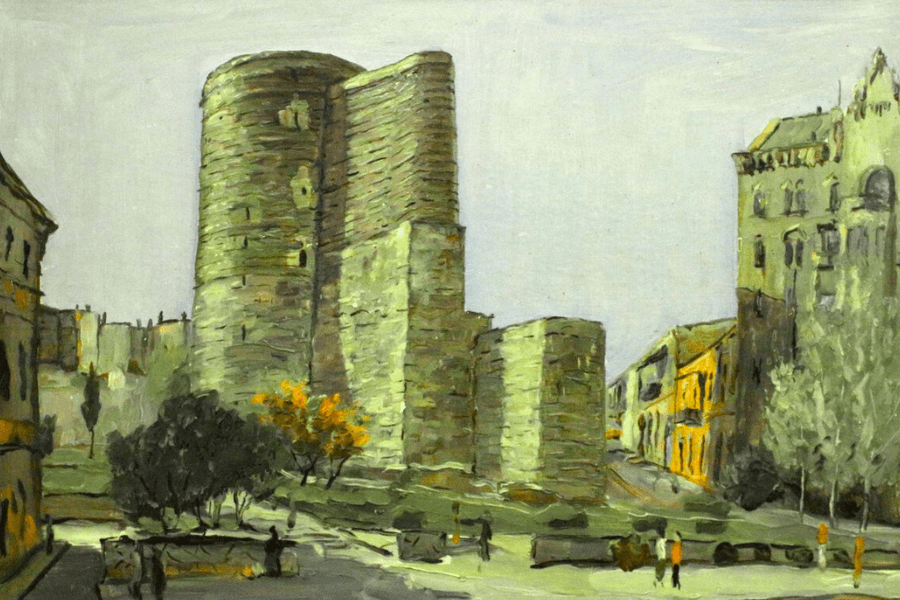
The Maiden Tower is one of the most mysterious structures not only in Baku, but in the entire East. Located in the southeastern part of the Icherisheher fortress, it has long become an architectural and cultural symbol of Azerbaijan’s capital. Despite decades of research, the tower still has no definitive explanation regarding its origin or original purpose.
The uniqueness of the Maiden Tower lies not only in its age or unusual shape. It is a rare example of a structure that simultaneously serves as a historical monument, a subject of academic debate, and a living cultural symbol that continues to influence art and the perception of the city.
Architecture of the Maiden Tower: Monumentality with Purpose
The Maiden Tower was built on a natural rocky outcrop along the coast and takes the form of a massive stone cylinder. Local grey limestone, typical of the Absheron Peninsula, was used in its construction.
Key architectural features include:
-
height of approximately 28 meters;
-
diameter of 16.5 meters;
-
wall thickness of up to 5 meters at the base and about 4 meters at the top.
Inside, the tower is divided into eight levels connected by a spiral stone staircase embedded within the wall. At the base, there is a 21-meter-deep well carved directly into the rock, suggesting a high level of engineering skill and possible autonomy of the structure.
Purpose of the Maiden Tower: Why the Debate Continues
The original function of the Maiden Tower remains one of the most complex questions in the architectural history of the region.
Why it is not a classical fortress
Although the tower was used for defensive purposes in later periods, its original design raises doubts:
-
there are no suitable conditions for long-term accommodation of a garrison;
-
typical defensive elements are absent;
-
the structure is too compact to function as a full-scale fortress.
A pre-Islamic cult structure
The most convincing theory suggests that the tower served a ritual purpose. Supporting evidence includes:
-
ancient ritual wells near the base;
-
the orientation of its windows;
-
the lack of clear defensive features.
Azerbaijani researcher Abbas Islamov identified a unique astronomical phenomenon: on the winter solstice (December 22), the rising sun’s rays enter precisely through the central window of the Maiden Tower and then sequentially illuminate the upper windows. This suggests a possible connection to sun worship, common in ancient belief systems of the region.
Fire temple, observatory, or dakhma?
Other theories propose that the tower was:
-
a fire temple;
-
a Zoroastrian dakhma used for ritual burials;
-
an ancient observatory.
However, none of these hypotheses has been conclusively proven. This lack of a single definitive explanation is precisely what makes the Maiden Tower unique and without direct analogues in the East.
Historical stages of use
Over time, the function of the Maiden Tower changed:
-
12th century — main citadel of the Baku fortress;
-
13th–19th centuries — navigation landmark and lighthouse;
-
since 1964 — museum;
-
since 2000 — UNESCO World Heritage Site.
The stone plaque bearing the date “12th century” on the façade is believed to be a later addition and cannot be considered reliable evidence of the construction period.
When was the Maiden Tower built?
The question of dating remains open:
-
based on mortar analysis — 1st century AD;
-
based on stone analysis — 9th century;
-
based on architectural comparisons — early Middle Ages.
Most likely, the tower was built in several stages, which explains the differing assessments.
Legends and cultural significance
The term “maiden” appears in the names of many towers in the East, meaning “unconquered” or “impregnable.” However, the Baku legend carries particular emotional weight.
The most famous story tells of a ruler who decided to marry his own daughter. Hoping to delay this fate, she asked him to build a tower. When it was completed, she climbed to the top and threw herself into the sea, choosing death over submission.
This legend inspired:
-
a poem by Jafar Jabbarly (1923);
-
the first Azerbaijani feature film (1924);
-
the first national ballet by Afrasiyab Badalbeyli (1940).
The Maiden Tower in art and culture
Images of the Maiden Tower appear:
-
in paintings by Alexey Bogolyubov and other artists;
-
on Soviet and Azerbaijani postage stamps;
-
in modern graphic art and design.
The tower continues to inspire artists to this day.
What to see inside the Maiden Tower
Today, the Maiden Tower functions as a museum featuring:
-
archaeological finds such as ceramics and tools;
-
materials presenting different theories of its origin;
-
multimedia displays and interactive screens;
-
virtual books and QR-guides.
The upper level offers an observation deck with panoramic views of Baku and the Caspian Sea.
Why the Maiden Tower is a must-see
The Maiden Tower in Baku is more than a tourist attraction. It is a rare structure that:
-
has no single definitive explanation;
-
unites science, myth, and art;
-
remains relevant after thousands of years.
That is why exploring Baku naturally begins here.